post

Mukuni Education is Key

For an orphan in Mukuni Village going to school is the highlight of their life. When you live in one of the poorest communities in the world there are no computers, IPods or TVS. Mud huts have no electricity, so school is the only place they can learn and they love it! To reach Mukuni some children have to walk as much as ten miles each way often having no breakfast before leaving home, this is ok when you are sixteen but far too far if you are only six. I drove out to Siachilobe to actually judge the distance the older children walk from their village to Mukuni, it’s a long, long way especially when the temperatures soar to over 40 degrees.

The Butterfly Tree is currently supporting six schools in the Mukuni Chiefdom but we need more classrooms to upgrade these schools so that the children do not have to spend too many hours of their day walking. We are currently raising funds for a Science block at Mukuni to complete our high school project. Ngandu has been able to upgrade to grades 8 and 9 as a result of the charity renovating an old classroom, last month we have commenced develoment at Katapazi school.

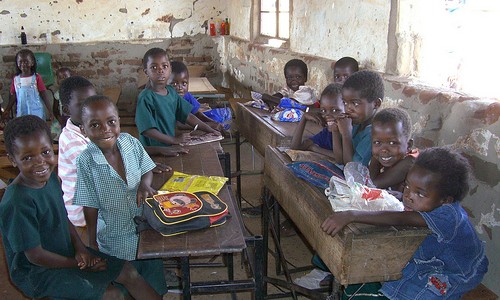
Mukuni Education classroom in need of restoration

Now we needs funds for Kamwi and Siamasimbi two remote schools that receive no other support from the outside world. Siamasimbi becomes inaccessable during the rainy season therefore is is imperative to develop the school. We insist on community participation by asking the villages to make bricks, provide river sand and fetch water; the government provides the teachers therefore we also need to source funds for teachers’ houses.

Education is the key to developing these rural schools, building classrooms, providing safe, clean water and feeding programs. Sponsor an orphan and give a vulnerable child a chance in life.

Classrooms for Zambia

During the recent teacher’s strike I am sure that many of you had sympathy for the wonderful people who educate our children. If you think that they are badly done to in this country, in Zambia, where the average monthly pay for a teacher is £100, teachers have to endure appalling living conditions. They have no choice of schools, a teacher can be sent anywhere throughout the country, and despite having lived in a town or city, they suddenly find themselves in the middle of the bush with no plumbing or electricity.

At Mukuni Village I see teachers living in leaking storerooms, tuck shops and classrooms, sharing a pit-latrine toilet and an ‘open air’ bathroom, using bowls of cold water to wash with. Sadly The Butterfly Tree receives very few donations to build teacher’s houses, despite the fact that teachers are the backbone of these remote schools. In one house where there are five male teachers, with only four rooms, one poor guy has to sleep in a cupboard. It is these teachers who are helping the orphans to overcome their hardships and find a way to better their lives.

As well as having poor living conditions the teachers are also battling with inadequate facilities. Many classrooms are in desparate need of restoration, books are in short supply and the sports facilities are virtually non-existant, with numerous schools having to use ‘bag and string’ footballs and the gymnasts training on the ‘dirt’ ground. Most rural schools have no plumbing or electricty, many are without even a bore hole, and some with no facilities at all, use using the shade of a mango tree to conduct their lessons.

Zambia Classroom
Photo: Classroom in Zambia

We are seeking corporates and individuals to sponsor a teacher’s house or classroom, with a donation between £5000 – £20000 you could make a difference to an entire Zambian community.

Mukuni Village Education

The improvements in education made by The Butterfly Tree over the past two years at Mukuni Village is having a positive effect on the community.

With the addition of Mukuni high school, now in it’s second year, pupils are able to complete grades ten to twelve of their education with a far better prospect of finding employment and with the boom in the Zambian tourist industry more positions will be available to school leavers.


Photo: Pupils have made these bricks for the high school science laboratory

The addition of Mukuni pre-school totally funded by The Butterfly Tree now has 198 children attending three classes throughout the day. With very little entertainment in these remote villages young children can learn to read and write and speak English at a much earlier age. Read More

Ngandu School Project

Last October I visited the remote village of  Ngandu, also in the Mukuni Chiefdom and a ‘feeder’ school to Mukuni Basic and High Schools.

Ngandu School was founded by the Roman Catholics in 1939. The first pupils were taught under a tree, there were no books or boards so they used to write on the ground with their fingers.

  • In 1940 a small hut was erected to accommodate one class while the other remained under the tree.

  • By 1944 a classroom block was made of grass to cater for both classes. The teachers were accommodated by the Headman before two huts were eventually built for them.

  • By 1947 a further classroom block and two teachers’ huts were added and a weekly boarding system was introduced for pupils walking great distances.

  • In 1948-1953 permanent buildings constructed and boarding facilities were provided, with the addition of two classrooms blocks for standards five and six in 1954.

After the government took over the running of Ngandu School in 1966, changing the standards to grades, very little has been done to improve the infrastructure.

Ngandu school classroom before restoration work

Ngandu school classroom before restoration work

Ngandu School has produced notable people including Ministers, Directors and Chiefs and catered for both the Southern and Western Provinces of Zambia. Sadly they all seem to have forgotten about their rural routes as the school is in desperate need of restoration and funding.
Read More